Materials
Concrete Pavers: What to Know Before Choosing a Surface
Concrete pavers are individually manufactured units used for patios, walks and some driveways. In an interlocking system single units can be lifted out for access or repair. This page explains how products differ. Ask about local availability before settling on a particular product.
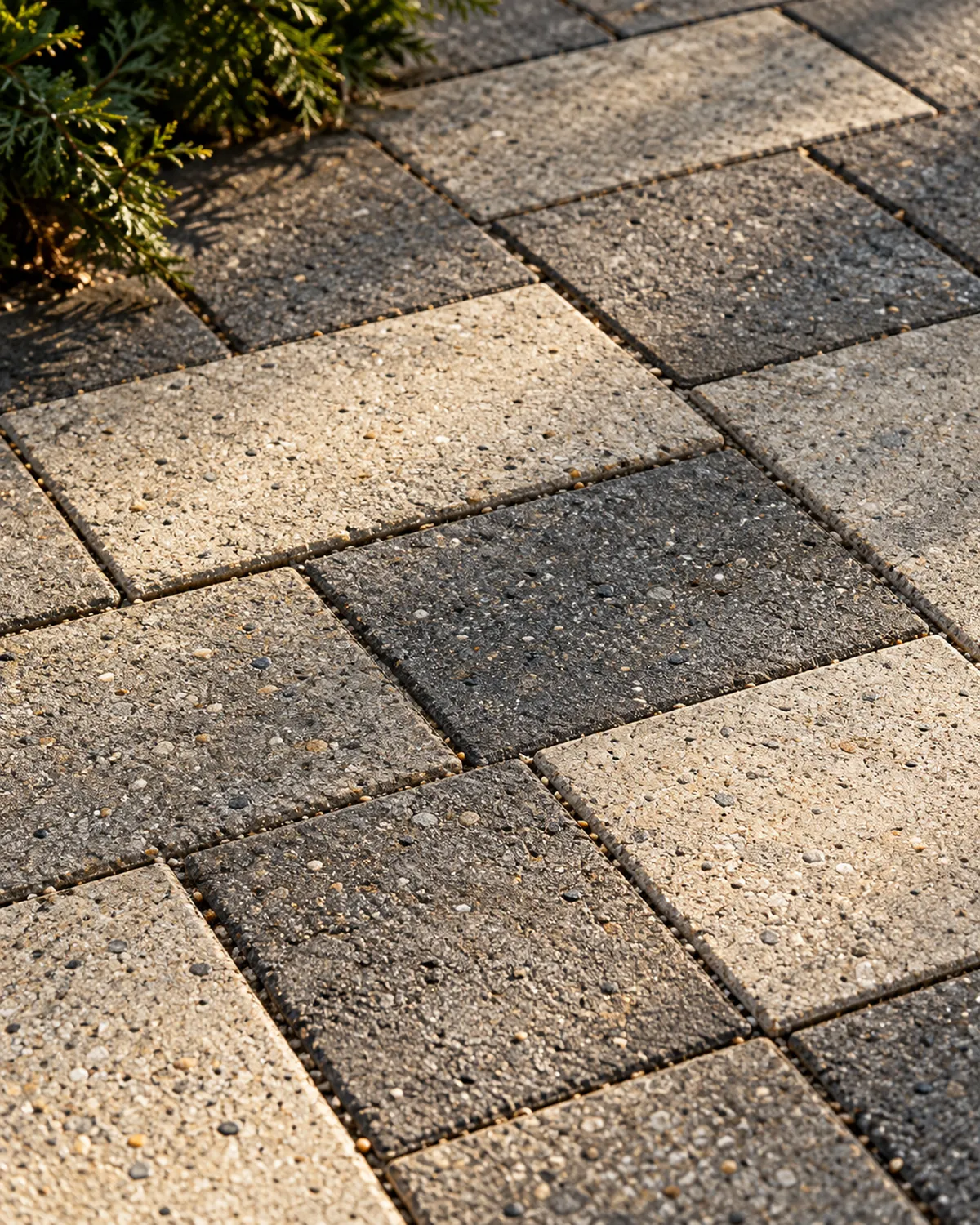
What a concrete paver is
A concrete paver is a precast unit of cement, aggregate and water, pressed and cured to consistent dimensions. Color is typically mixed through the unit rather than painted on, although surface color can soften over years of weather and wear. New pavers sometimes show efflorescence, a whitish mineral haze that usually fades on its own.
Interlocking units and larger slabs
Classic interlocking pavers are relatively small and thick and rely on tight joints, sand and edge restraint to act as one flexible surface. Large-format slabs give a cleaner look with fewer joints, but they behave differently under load and are more sensitive to an uneven base. Ask how the supplier recommends using the specific product you like.
What the ASTM C936 standard covers
In the United States, solid interlocking concrete paving units are commonly specified to ASTM C936. As summarized in manufacturer and specification documents, the standard sets requirements including:
- average compressive strength of at least 8,000 psi, with no single unit below 7,200 psi;
- average water absorption of no more than 5%, with no single unit above 7%;
- freeze–thaw durability tested in a salt solution, which is directly relevant to Minnesota winters;
- limits on abrasion loss and on variation in dimensions.
Secondary summaries of ASTM C936 (manufacturer documentation reviewed in research, Oct. 2026); the official text was not accessed.
Meeting the standard does not make a product right for every use or prove it was installed correctly. Ask the supplier for the product's actual test documentation.
Matching a paver to its use
A patio and a driveway are different design problems. Industry guidance commonly cites units around 60 mm (2⅜ inches) thick for pedestrian areas and around 80 mm (3⅛ inches) for vehicle areas. Pattern, base and edge restraint also change with the load; see walkways vs driveways.
| Planned use | What usually changes | Ask the supplier or installer |
|---|---|---|
| Patio or seating area | Finish, color and pattern drive appearance; foot traffic only | Is this unit rated for pedestrian use and freeze–thaw exposure? |
| Walkway or entry | Traction when wet or icy, edges along lawn, snow shoveling | How does this finish perform wet and in winter? What edge do you recommend? |
| Driveway or parking pad | Thicker units, vehicle-suited pattern, deeper base, stronger edges | Is this product and pattern intended for vehicles? What base do you propose? |
| Pool or wet area | Slip resistance, drainage, sealer choice | What does the manufacturer say about wet-area traction and sealing? |
Surface finish and traction
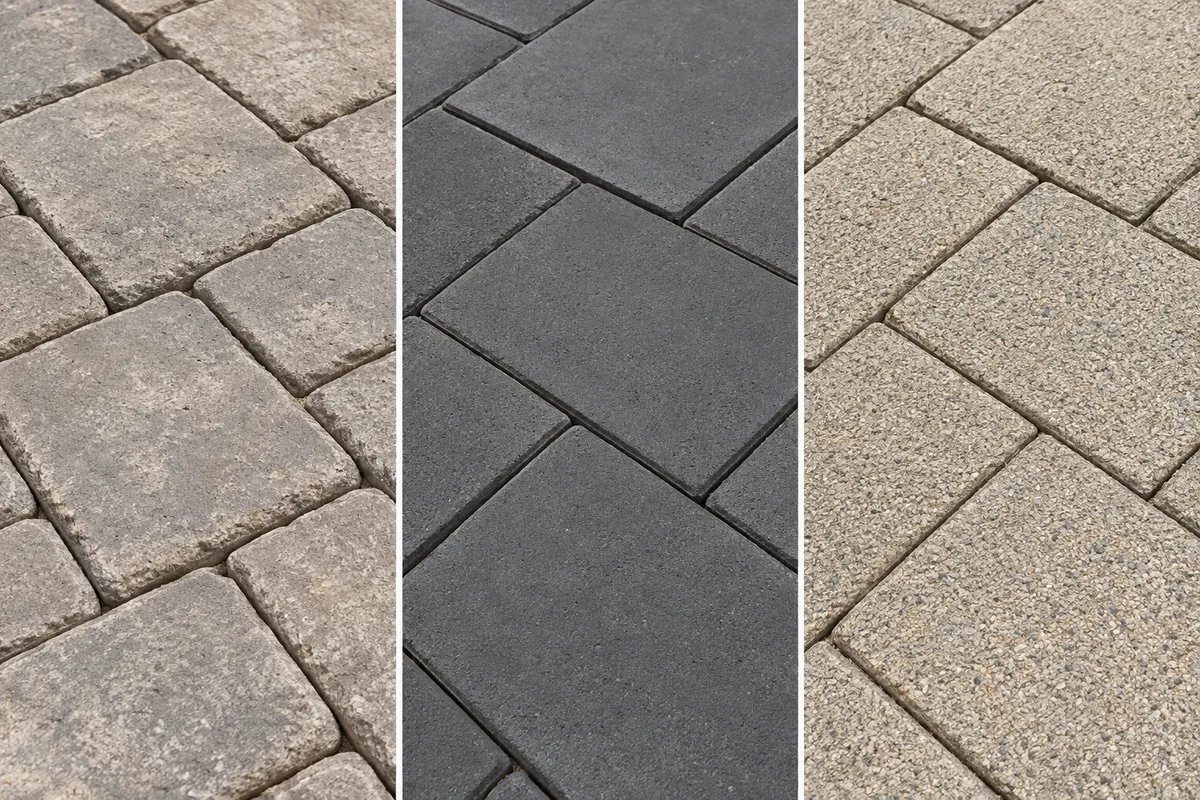
Smooth, tumbled and textured finishes look and feel different. Moisture, ice, sealers and texture all affect traction, and no finish removes slip risk. Neither a photograph nor an illustration shows exactly how a product will look at your home, so look at real samples outdoors in different light.
Laying patterns
The same paver reads very differently in different patterns. Running bond is simple and quick to lay; herringbone interlocks in two directions and suits driveways; borders and curves add cutting and cost. Patterns, waste and borders are compared in paver patterns and designs.
Concrete, clay brick or natural stone?
Comparing pavers with a poured slab instead? See pavers vs. poured concrete.
| Concrete pavers | Clay brick pavers | Natural stone | |
|---|---|---|---|
| Common standard | ASTM C936 | ASTM C902 (confirm the weathering grade) | Varies by stone type |
| Design range | Widest range of shapes, colors and textures | Classic look, narrower color range | Natural variation in every piece |
| Color over time | Can soften gradually | Fired-in color holds well | Ages with the stone |
| Cold-climate note | Look for saline freeze–thaw testing | Use units rated for severe weathering | Dense, low-absorption stones preferred |
| Published lifespan | 25–50 years with proper installation (guides agree) | 30–50 years in one guide; 75+ years in another | 50–100 years in one guide; 50–75+ in another |
| Repair and matching | Single units lift out; keep spares from the same run | Single units lift out; fired-in color helps later matches | Single units lift out; natural variation makes exact matches harder |
| Upkeep | Joint top-ups; sealing optional or periodic by product | Joint top-ups; color does not need sealing to hold | Varies with density and absorption |
| Installed cost, one national guide | $8–$16 per sq. ft. | $14–$24 per sq. ft. | $12–$30 per sq. ft. |
Cost row: HomeServe, checked Oct. 25, 2026; national figures, not Faribault prices. Other sources differ; see the cost guide. Lifespan rows: published ranges summarized in research, with clay and stone figures in disagreement; they assume sound installation and are not guarantees.
Before you choose a product
Three groups of questions to settle with the supplier or installer, using a real sample rather than a photo.
Traction
- Have you seen the finish outdoors, wet and dry?
- How does it behave with ice and snow shoveling?
- Does a sealer change the traction, and which one is specified?
Finish and color
- Is color mixed through the unit or only on the surface?
- Which cleaning methods and de-icers does the maker allow?
- Will matching units from the same run be available for repairs?
Durability
- Is there documentation for ASTM C936, including the freeze–thaw test?
- Is this thickness and shape intended for the load?
- Which joint material does the manufacturer specify?
Limitations and upkeep
Concrete pavers are not maintenance-free. Joints can lose material and grow weeds, surface color can soften, and the surface is only as stable as the base under it. Sources disagree about how safe some chloride de-icers are for concrete, so no single de-icer can be called safe for every surface; sand or grit adds traction without chemical effects. See winter paver care.
Common questions
Can a damaged paver be replaced?
In most interlocking systems, yes: individual units can be lifted and replaced. If settling or drainage caused the damage, fix that cause too, or the problem will come back.
Do concrete pavers need sealing?
Sources disagree. Some manufacturers and installers recommend periodic sealing for color, stain resistance or water repellency; others treat it as optional for interlocking pavers. Follow the product manufacturer's guidance, and avoid sealing new pavers too early, since it can trap efflorescence. Intervals and cure times are compared in paver sealing and maintenance.
Sources and limitations
- ASTM C936, Standard Specification for Solid Concrete Interlocking Paving Units — ASTM International. Requirements as summarized in manufacturer documentation (Techo-Bloc installation guide) and specification documents reviewed in research, October 2026. Limitation: The official standard text is sold by ASTM and was not accessed; figures are secondary summaries. Ask for the product's own test certification.
- ICPI guidance on typical unit thickness and joint widths — Interlocking Concrete Pavement Institute, now part of the Concrete Masonry & Hardscapes Association (CMHA). About 60 mm (2⅜ in.) for pedestrian use and 80 mm (3⅛ in.) for vehicles; as summarized in research reviewed October 2026. Limitation: Typical values, not a product recommendation for a specific site.
- Patio Installation Costs (2026) (opens in a new tab) — HomeServe. Checked October 25, 2026; installed per-square-foot ranges of $8–$16 for concrete, $14–$24 for brick and $12–$30 for natural stone pavers. Limitation: National consumer guide; local prices vary.
- Paver Patio Build Cost (opens in a new tab) — Elevate Outdoor (Midwest/Northeast contractor). Re-checked October 25, 2026: concrete pavers last 25–50 years with proper installation and maintenance. Limitation: Contractor guidance, not an independent study.
- Clay and natural stone lifespans, summarized in research — Bonita Stone; EngineerFix; other material guides. As summarized in research reviewed October 2026: clay 30–50 years (Bonita Stone) vs 75+ years, some over a century (EngineerFix); natural stone 50–100 or 50–75+ years by guide. Limitation: Not re-checked at each source for this page; longer figures assume ideal conditions.