Paver walkways
Paver Walkways: Routes, Base and Winter Planning
A walkway is a route, not a room. It has to connect two places, carry people safely in every season and shed water — which makes its design questions different from a patio's, even when the pavers are the same.
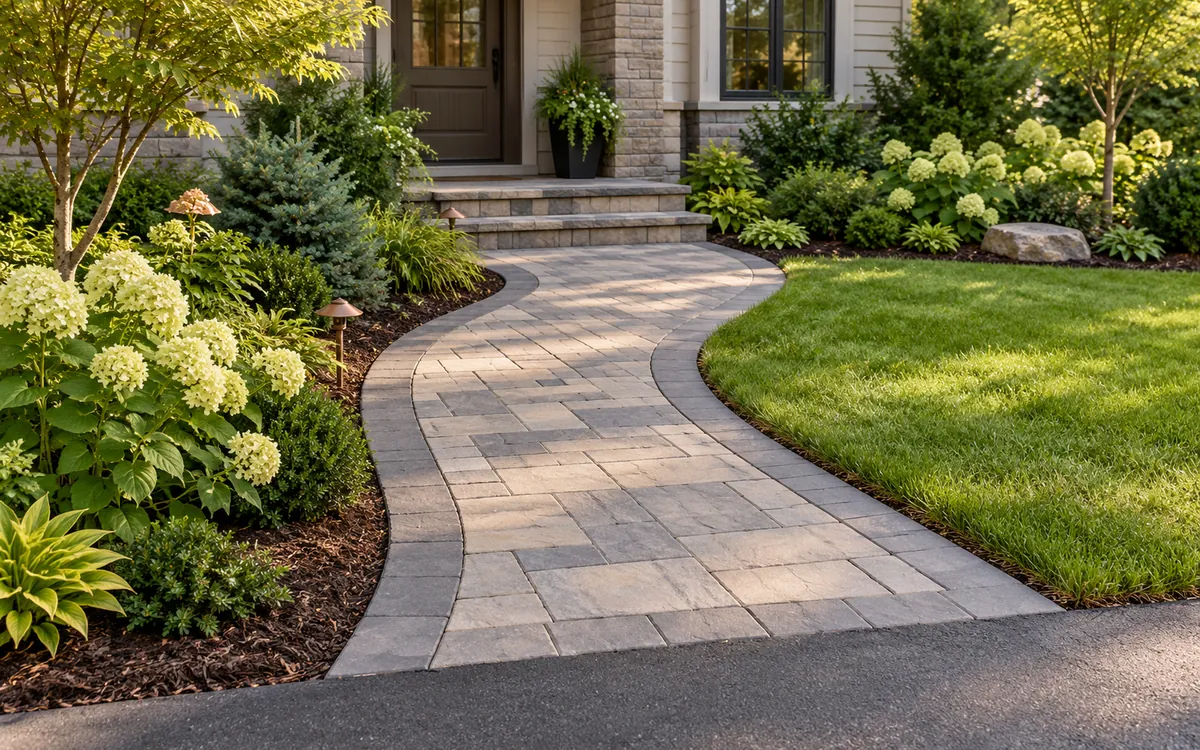
Start with the route
Watch where people already walk — worn lawn is a good guide — and plan the path to follow it. A route that forces a detour gets ignored, and the lawn wears anyway.
| Route | Connects | Why it matters | Plan for |
|---|---|---|---|
| Front entry | Street or driveway to the front door | First impression; must be clear and safe in winter | Steps, landings and door thresholds; snow piles from the driveway |
| Side-yard path | Driveway or gate to the backyard | Keeps foot traffic off lawn and mud | Narrow access for equipment; drainage between houses |
| Garden or patio link | Back door or patio to beds, sheds or play areas | Ties the yard together; can curve to follow planting | Curves add cutting; edges along lawn need restraint |
| Service route | Garage to trash, compost or utility areas | Durable route for carts and wheeled bins | Wheeled loads and possible light vehicle crossings change the design |
Width, curves and steps
Think about who uses the path: two people side by side, a stroller, a wheelbarrow or a wheeled trash bin. Mark the route on the lawn with a hose or string and walk it with whatever you will roll along it. Gentle curves look natural and can follow planting beds, but every curve and border adds cutting. Where the ground rises steeply, a step or landing is usually safer than a steep paved slope, especially once ice forms.
The base and edges under a walkway
A walkway uses the same layered system as a patio — prepared subgrade, compacted aggregate base, a thin bedding layer, pavers with filled joints, and an edge restraint. Industry guidance cited by secondary sources gives about 4 inches of compacted base on well-drained soil as the pedestrian minimum, with thicker bases on cold, wet or weak soils. Base thickness for your site is the contractor's call after seeing the ground; see why base depth varies and the Minnesota base and drainage guide.
Walkways have a lot of edge for their size, usually against lawn. Edge restraint is required for sand-set interlocking pavers and should sit on the base, which extends past the paver edge. Without it, long straight runs tend to creep outward and joints open.
Water and slope
A walkway beside a house should fall away from the foundation — guidance citing the International Residential Code gives a minimum of 2% for hard surfaces near foundations. Along its length, a path also needs somewhere for water to go: a low spot at the bottom of a run becomes an ice patch in winter.
Winter use
Traction
- Textured finishes grip better than smooth ones when wet
- No finish removes slip risk; sealers change traction
- Keep moss and algae off shaded paths
Shoveling
- Clear snow promptly so it does not pack into ice
- A plastic shovel blade is less likely to scratch
- Plan where shoveled snow goes, away from the path's low end
De-icing
- Sources disagree on chloride de-icers
- Follow the paver maker's guidance
- Sand adds traction without chemicals
Details and the source disagreements are in winter paver care.
Questions to ask about a walkway quote
- What base thickness do you propose for this soil, and where does it change (for example at a driveway crossing)?
- How will the path drain along its length and at the house?
- Which edge restraint do you use along lawn edges, and how is it anchored?
- How will steps, landings and door thresholds be handled?
- Which paver and finish do you recommend for winter traction, and why?
For budgeting, the drivers are the same as for patios — see the cost guide. Long, narrow paths have more edge restraint and cutting per square foot than a compact patio.
Walkway questions
Does a walkway need the same base as a driveway?
No. A path for foot traffic and light carts is a pedestrian design. If any part will carry vehicles — for example where it crosses a driveway — that section needs the vehicle design described on the paver driveway page.
Can an old concrete walk be covered with pavers?
Sometimes, if the slab is sound, drains and leaves enough height at doors and steps. The trade-offs are covered in pavers over concrete.
Sources and limitations
- Paver & Patio Installation: The Complete Technical Guide (opens in a new tab) — RemodelCalculators. Checked October 25, 2026; ICPI pedestrian base minimum (4 in. on well-drained soil), mandatory edge restraint with base extending at least 6 in. past the paver edge. Limitation: Secondary source citing ICPI Tech Specs; not a design for a specific site.
- Should Your Patio Go Right Up to the House? (opens in a new tab) — EngineerFix. Checked October 25, 2026; hard surfaces should slope away from the foundation at a minimum of 2% (citing the IRC). Limitation: Secondary guidance; local code governs.
- Winter care, traction and snow-removal guidance summarized in research — A1 Concrete; Natural Environments Corp; Perfect Pavers. As summarized in research reviewed October 2026: clear snow promptly, plastic shovel to avoid scratching, raised blade on permeable surfaces, no finish removes slip risk. Limitation: Not re-checked at the source for this page; single-source guidance.