Paver driveways
Paver Driveways: Designing for Vehicles and Minnesota Winters
Pavers can make a handsome driveway that is repairable one unit at a time — but only if the system is built for cars, turning tires and snow removal. This page covers what changes compared with a patio and what to ask before you hire.
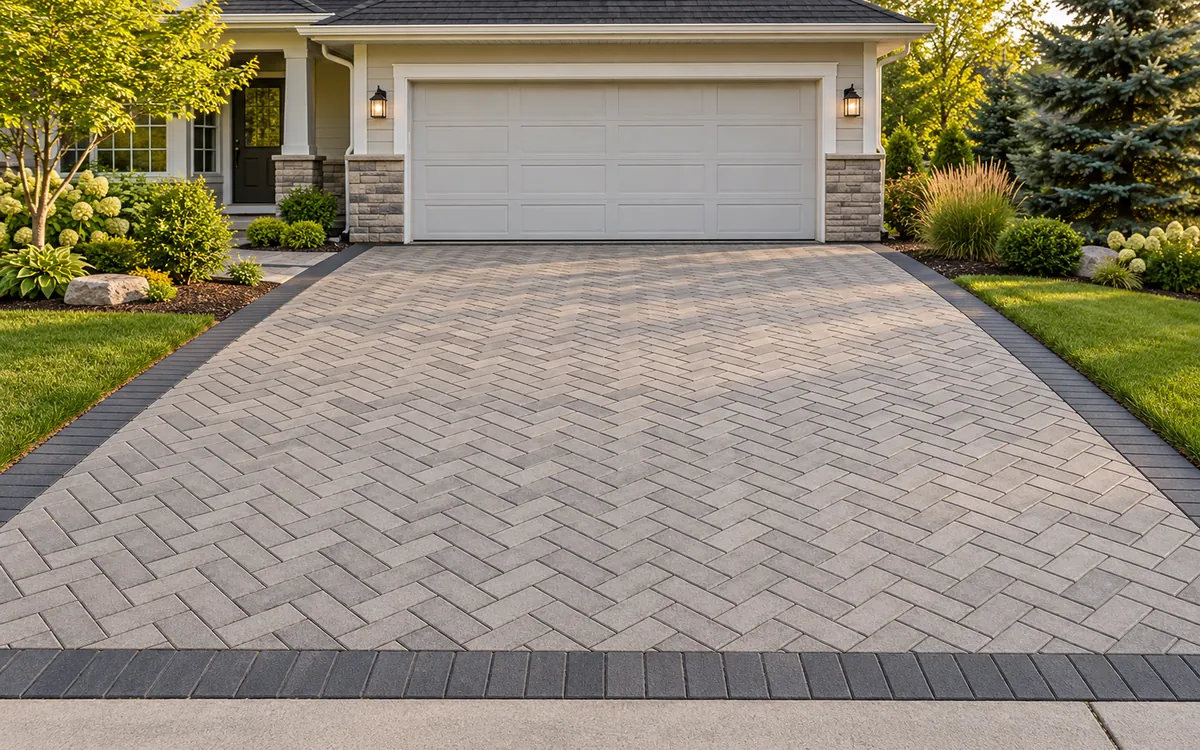
Why a driveway is a different design
A patio carries people and furniture, and a walkway carries foot traffic. A driveway carries the concentrated weight of tires, plus the twisting force of a car turning in place, every day. Those loads push units apart and press the base down, so every layer of the system has to be specified for vehicles. Most early driveway failures — ruts, sunken wheel paths and spreading edges — come back to a base or edge that was built to a patio standard.
Driveway vs patio, side by side
| Patio or walkway | Residential driveway | |
|---|---|---|
| Typical paver thickness | About 60 mm (2⅜ in.) | About 80 mm (3⅛ in.) |
| Minimum base, well-drained soil | About 4 in. | About 6 in. |
| Cold, wet or weak soil | Thicker in both cases (one guide: 50–100% more); driveway practice often runs 8–12 in. | |
| Laying pattern | Any; running bond is common | Herringbone recommended |
| Edge restraint | Required | Required; sturdier where plows hit |
| Compaction | Base compacted in layers; specifications for vehicle areas are stricter | |
Industry guidance as cited by secondary sources (see sources below). Typical values, not a design for your site.
Pattern and interlock
In a herringbone pattern, each unit is locked by its neighbours in two directions, so turning tires cannot easily push a row sideways. ICPI's Tech Spec 4, as cited by secondary sources, recommends herringbone for vehicular areas because other patterns can have lower structural capacity and resistance to lateral movement. Running bond is fine on a patio, but its continuous joint lines are weaker under turning wheels. Herringbone also needs more cuts along edges, which adds labor and waste — expect it to show up in the quote. Patterns are compared in paver patterns and designs.
Edges, plows and snow
- Edge restraint is mandatory for sand-set pavers. One guide recommends a concrete curb where snowplows touch the surface, because plastic or metal edging is more easily damaged.
- Plow blades can catch raised paver edges. If a plow service clears your drive, ask about blade height and shoe settings, and make sure the finished surface is flush.
- Snow storage needs a planned spot where melt runs away from the garage and does not refreeze on the drive.
More on de-icers and snow removal is in winter paver care.
Drainage at the street and garage
A driveway collects water from a large area and often runs toward the garage or the street. The surface — and the base beneath it — should be graded so water leaves the garage slab and does not pond in wheel paths, where it can freeze and soften the base in spring. Ask how the contractor will handle the transition at the garage, the sidewalk and the street apron, and whether any of those edges are on public right-of-way that needs city approval. Why water and frost matter so much here is explained in the Minnesota base and drainage guide.
Concrete, brick or stone for a driveway
Concrete pavers made for vehicle use are the most common driveway choice; ask for the product's ASTM C936 test documentation and confirm the thickness is intended for vehicles. Clay brick pavers can carry vehicles when rated for it, and brick driveways are traditionally laid in herringbone. Natural stone varies too much by type and thickness to generalize — the supplier must confirm it for vehicle loads. See concrete pavers for the material comparison.
Questions for a driveway quote
- What base material and thickness do you propose for my soil, and how is it compacted?
- Which paver and thickness, and is it rated for vehicles?
- Which pattern, and how are the edges at the garage, sidewalk and street handled?
- What edge restraint do you use where a plow or shovel will hit?
- Is removing the old driveway, hauling and disposal included?
- How long until the drive can be driven on, and what do your written terms say about settling?
Published cost ranges on this site are for patios; driveway work usually costs more per square foot because of thicker units and deeper bases. The drivers that move any quote are in the cost guide.
Driveway questions
Can a patio contractor install a driveway the same way?
Not the same way. Vehicles need thicker units, a deeper and well-compacted base, a vehicle-suited pattern and stronger edges. Ask any contractor to describe how their driveway design differs from their patio design.
How long does a paver driveway take to install?
One contractor guide (Florida) gives 3–5 business days on site for a 1,200–2,000 sq. ft. driveway. Removal of an old surface, base depth, access and weather all change that, and no Faribault-specific schedule was found in our research.
Can pavers go over an existing asphalt or concrete driveway?
It depends on the existing surface, drainage and finished heights; a vehicle load makes the assessment stricter, not looser. See pavers over concrete for the trade-offs.
Sources and limitations
- Paver & Patio Installation: The Complete Technical Guide (opens in a new tab) — RemodelCalculators. Checked October 25, 2026; ICPI Tech Spec 2 base minimums (4 in. pedestrian, 6 in. residential drive) with 50–100% more on cold, wet or weak subgrade; ICPI Tech Spec 4 recommends herringbone for vehicular traffic; edge restraint mandatory. Limitation: Secondary source citing ICPI (now CMHA) Tech Specs; official editions not checked.
- Typical unit thickness, contractor base practice, plow and timeline notes — Industry and contractor guides summarized in research (ICPI practice; Three Timbers; FixUpFirst; EngineerFix; Craft Pavers; RemodelCalculators). As summarized in research reviewed October 2026: about 80 mm (3⅛ in.) units for vehicles; 8–12 in. bases common in driveway practice; concrete curb restraint where plows touch (one guide); 3–5 days on site for 1,200–2,000 sq. ft. (one Florida guide). Limitation: Not re-checked at each source for this page; several are single-guide figures.