Homeowner guide · Design
Paver Patterns and Designs: How to Choose One That Works
The laying pattern decides more than looks. It changes how well the surface resists traffic, how many units get cut and wasted, and how much labor a quote includes. This guide compares the common patterns so you can choose one deliberately.
Patterns compared
| Pattern | Look | Interlock | Cutting waste | Best suited | Watch for |
|---|---|---|---|---|---|
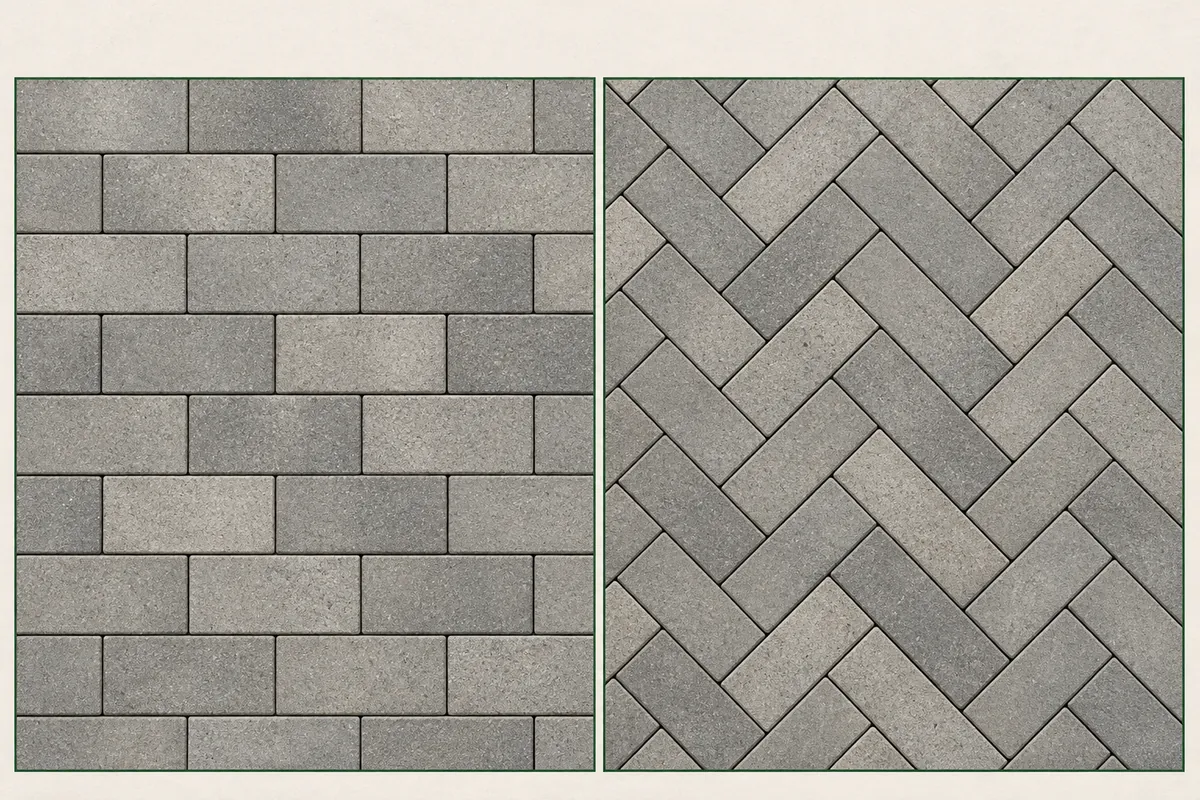
| Running bond | Rows offset like brickwork; calm and linear | Interlocks along rows; weaker under turning wheels | About 8% (one guide) | Patios, walkways | Long joint lines emphasise direction |
| 90° herringbone | Zig-zag of rectangles, square to the edges | Strong two-way interlock | More than running bond | Patios, drives | More cutting at edges |
| 45° herringbone | Zig-zag set diagonally to the edges | The orientation ICPI guidance requires for driveways | About 13% (one guide) | Driveways, large patios | Most cuts along every edge |
| Basketweave | Pairs of units alternating direction | Decorative; described as a decorative choice | Moderate | Patios, entries | Traditional look; check suitability for vehicles |
| Circular or fan | Rings or arcs around a centre point | Focal feature | Nearly three times running bond (one guide) | Patio centrepieces | Most labor and waste |
Why pattern affects strength
Interlocking pavers work as a system: joints, joint sand and the edge restraint let units share load with their neighbours. In running bond, units lock along each row but continuous joint lines run the other way, so a turning tire can push a row sideways. In herringbone, every unit is held in two directions. That is why secondary sources citing ICPI guidance treat herringbone as the vehicular pattern, with the 45° orientation required for driveways. On a patio or walkway that only carries foot traffic, any common pattern can perform well on a sound base.
Pattern, cutting and cost
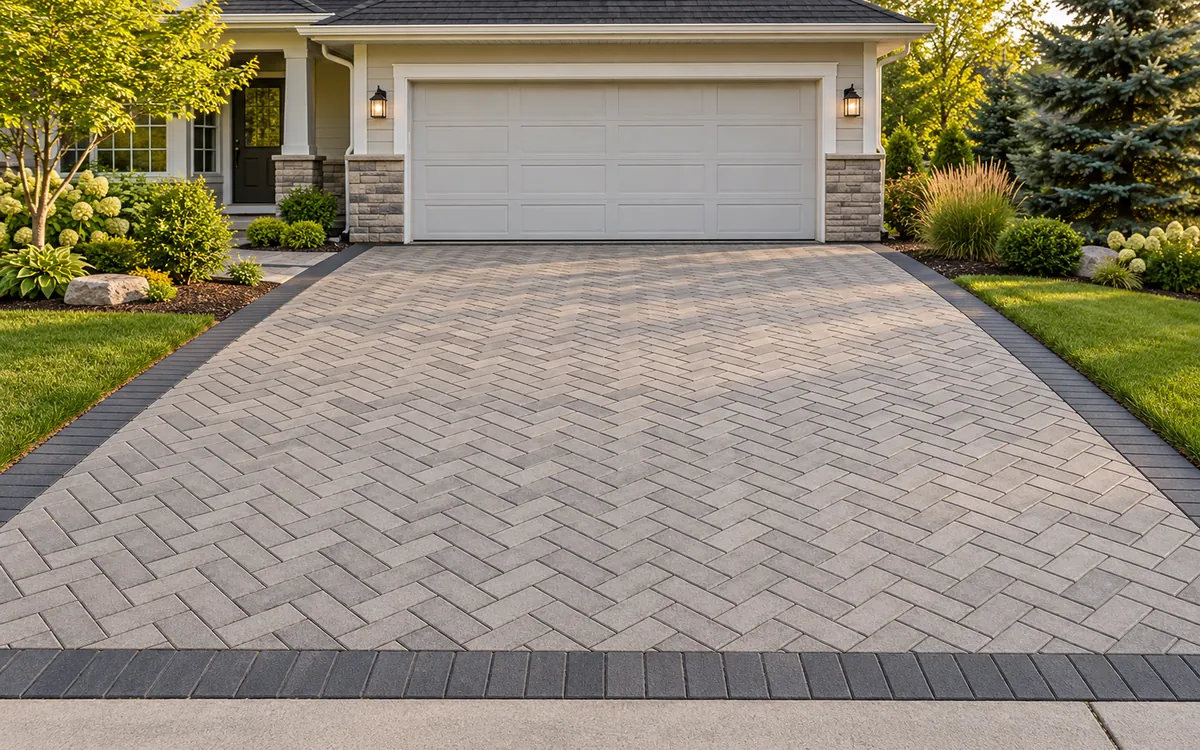
One technical guide calls pattern "the single biggest driver of paver waste": about 8% for running bond, about 13% for 45° herringbone and nearly three times running bond for a circular fan. Every diagonal or curve means units cut at the edge, and cutting is labor. A national cost guide reaches the same conclusion from the price side — running patterns are usually cheaper and quicker, complex patterns can cost significantly more. Published price ranges are compared in the cost guide.
Borders and accents
- Soldier course: a single row of units set end-to-end around the edge; it frames the field and gives the edge restraint a clean line.
- Contrasting color: a darker or lighter border defines zones — a dining area, a path through a patio — without changing material.
- Inlays and bands: a strip in a second pattern or color across a large patio breaks up the field; each adds cutting.
- Curved edges: soften the line against lawn and planting; curves always mean cut units along the border.
Layout and zoning decisions — where the dining area goes, how wide the path is — belong to patio planning.
Unit size and scale
Smaller units and busy patterns read as texture in a small yard; larger units and simple patterns feel calmer and more modern. Large-format slabs have fewer joints but are more sensitive to an uneven base. Thickness is a separate question — it follows the load, not the look; see matching a paver to its use.
Choosing by project
Patio
- Any common pattern on a sound base
- Running bond or basketweave for economy
- Borders to define zones
Walkway
- Simple patterns limit cutting along long edges
- A soldier-course border keeps edges tidy
- Herringbone where it crosses a drive
Driveway
- Herringbone, 45° where guidance requires it
- Vehicle-rated units and base
- A strong border at the street and garage
Walkway and driveway design questions are covered in paver walkways and driveway patterns.
Pattern questions
Which pattern is cheapest?
Running patterns are usually the quickest and cheapest to lay; complex mosaic or circular patterns can cost significantly more, mostly through cutting labor and waste. See what changes the price.
Can I mix patterns?
Yes — a field in one pattern with a border or inlay in another is common. Each change of pattern adds a joint line to cut and fit, so expect it in the quote.
Sources and limitations
- Paver & Patio Installation: The Complete Technical Guide (opens in a new tab) — RemodelCalculators. Checked October 25, 2026: "Pattern is the single biggest driver of paver waste"; running bond about 8%, 45° herringbone about 13% (the ICPI-required orientation for driveways), basketweave decorative; a circular fan wastes nearly three times as much as running bond. Limitation: Secondary source citing ICPI (now CMHA) guidance; waste figures are typical, not a quote basis.
- Patio Installation Costs (2026) (opens in a new tab) — HomeServe. Checked October 25, 2026: running patterns are usually cheaper and quicker to install; complex mosaic or circular patterns can be significantly more expensive. Limitation: National consumer guide.